Custom Keycap Production Cost Per Set Bulk: A 2025 Guide
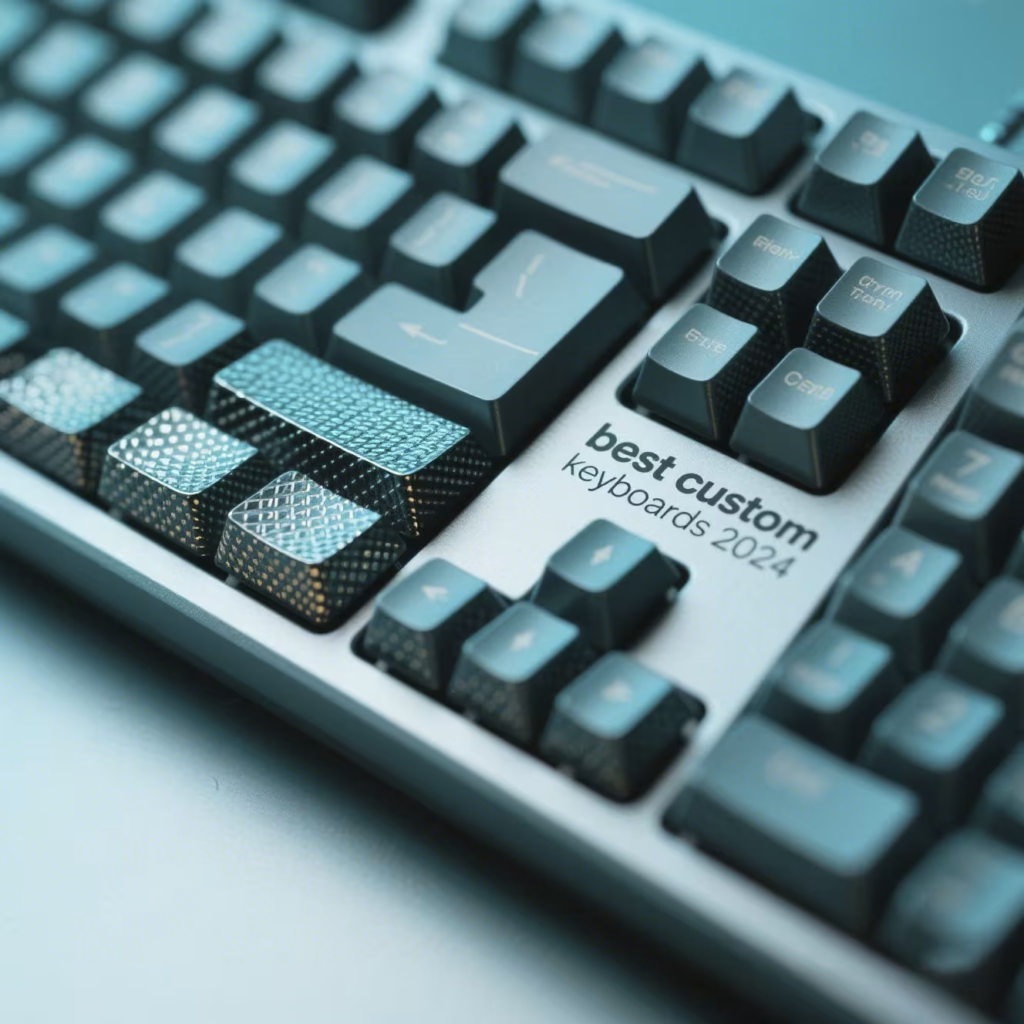
For keyboard brands, design studios, and distributors, understanding the custom keycap production cost per set bulk is essential for margin planning, inventory management, and competitive pricing. Unlike off-the-shelf keycaps, custom designs require dedicated tooling, material selection, and surface finishing processes that scale with order volume. This guide provides a transparent breakdown of cost drivers—mold investment, material choice, printing method, and packaging—so you can negotiate smarter with OEM manufacturers and accurately forecast per-set costs at quantities of 500, 1,000, 5,000, or more.
1. Core Cost Drivers in Custom Keycap Production
The final custom keycap production cost per set bulk is determined by four main factors: tooling amortization, raw materials, manufacturing method, and secondary operations (labeling, packaging). Each driver behaves differently as volume increases.
1.1 Tooling and Mold Investment
Injection-molded keycaps require steel molds per keycap profile (e.g., OEM, Cherry, SA, DSA). A full 104-key set mold typically costs between $8,000 and $25,000 USD, depending on cavity count, complexity (legends on the top vs. side-printed), and whether the mold includes multi-shot capabilities for double-shot keycaps. For bulk orders, this upfront cost is amortized across the total order quantity—higher volumes reduce the per-set tooling charge.
1.2 Material Choice
ABS (Acrylonitrile Butadiene Styrene) and PBT (Polybutylene Terephthalate) are the two primary thermoplastics. ABS is cheaper ($2.50–$3.50/kg) but prone to yellowing and shine over time. PBT is more expensive ($4.00–$6.00/kg) but highly durable and resistant to UV degradation. For custom keycap production cost per set bulk, PBT adds approximately $0.20–$0.50 per set compared to ABS, but customers perceive higher quality. Many OEMs recommend PBT for medium-to-high volume custom orders to balance cost and premium positioning.
1.3 Manufacturing Method
Three common processes affect cost: dye-sublimation (only on PBT), double-shot injection (ABS or PBT), and pad printing (economical but less durable). Dye-sub legends are infused into the plastic, so no additional layering is needed—saving secondary costs. Double-shot requires multi-material injection, increasing cycle time and tooling complexity. Pad printing is low-initial-cost but degrades over time, making it unsuitable for most B2B custom keycap programs.
2. Cost Comparison Table: Production Methods at Scale
| Method | Material | Mold Amortization (1,000 sets) | Material + Process Cost per Set | Estimated Bulk Cost per Set (1,000 qty) | Durability |
|---|---|---|---|---|---|
| PBT Dye-Sub | PBT | $2.50–$8.00 | $0.80–$1.20 | $3.30–$9.20 | Excellent (legends never wear) |
| ABS Double-Shot | ABS | $5.00–$15.00 | $1.20–$2.00 | $6.20–$17.00 | Good (legends embedded) |
| PBT Double-Shot | PBT | $6.00–$18.00 | $1.50–$2.50 | $7.50–$20.50 | Excellent |
| Pad Printing (full set) | ABS | $1.00–$3.00 (low mold cost) | $0.40–$0.70 | $1.40–$3.70 | Low (legends fade after months) |
Note: The table reflects typical OEM quotes for a standard 104-key ANSI layout. Additional charges apply for specialized profiles (e.g., SA profile requires more material and longer cycle times), custom colors per row (split-mold costs), and special packaging (e.g., individual switch-puller sliders).
3. Volume vs. Unit Cost: How Bulk Orders Reduce Price
The custom keycap production cost per set bulk decreases significantly as order quantities exceed 500 units. For example, a 1,000-set order of PBT dye-sub keycaps might cost $4.50 per set, while a 5,000-set order of the same design could drop to $2.80 per set—a 38% reduction. This is driven by:
- Amortized tooling: The fixed mold cost is spread over more units.
- Raw material discounts: PBT resin suppliers offer volume tier pricing for orders above 5,000 kg.
- Efficient production runs: Machine setup and color changeover times are minimized when running large batches.
- Consolidated logistics: Full container loads lower per-unit freight compared to LCL (Less than Container Load).
However, be aware of diminishing returns around 10,000 sets—further discounts become small (5–10%) because material and labor costs reach a floor. The optimal volume for most custom keycap projects is between 2,000 and 5,000 sets, balancing cost per set and inventory risk.
4. Hidden Costs in Custom Keycap Sourcing
Beyond the obvious manufacturing line items, there are several costs that can surprise first-time buyers. Accounting for these ensures your custom keycap production cost per set bulk estimate is accurate:
- Color matching: Custom Pantone colors require extra blending cycles; expect $100–$300 per color per order.
- Secondary operations: UV coating (matte or gloss) adds $0.30–$0.60 per set.
- Packaging development: Custom-printed boxes or trays add $0.50–$2.00 per set depending on design complexity.
- Quality control (QC): Third-party inspection or in-house QC for large volumes can be $0.10–$0.25 per set.
- Shipping & duties: Ocean freight from Asia (Shenzhen, Taiwan) for a 5,000-set order (approx. 1.5 m³) costs $0.40–$1.00 per set, plus import duties that vary by country.
For example, a brand sourcing 3,000 sets of PBT double-shot keycaps from an OEM in Taiwan should budget an additional $1.20–$2.50 per set beyond the base manufacturing cost.
5. Practical Sourcing Examples: Real-World Cost Scenarios
Scenario A: Niche Mechanical Keyboard Brand (500 sets)
An emerging design studio wants a limited-run SA-profile PBT dye-sub set with custom colors. Mold investment: $18,000. After amortization, the per-set tooling cost is $36.00. Material and process: $3.20 per set. Packaging (individual box with foam): $2.50. Total: $41.70 per set. To remain cost-effective, the brand may opt for a smaller mold (e.g., only the alpha-numeric keys) and use stock modifier molds, reducing per-set cost to ~$15.00.
Scenario B: Retail Chain Distributor (5,000 sets)
A retailer orders 5,000 sets of OEM-profile PBT dye-sub keycaps in four colorways. Mold cost ($12,000) amortized to $2.40 per set. Material + process: $1.65 per set. Simple blister packaging: $0.40. QC and shipping: $0.80. Estimated custom keycap production cost per set bulk: $5.25. With a typical margin of 40%, retail price can be set at approximately $8.80, competitive with mainstream aftermarket keycaps.
Scenario C: Corporate Branded Giveaway (10,000 sets)
A tech company orders custom ABS double-shot keycaps with logo legends for 10,000 sets. Mold cost ($9,000) amortization: $0.90 per set. Material + double-shot process: $1.20. Retail-grade packaging: $1.00. Total: $3.10 per set. At this volume, the per-set cost is low enough to allocate as a free add-on with keyboard purchases.
6. How to Choose the Right OEM for Bulk Keycap Production
When evaluating suppliers for custom keycap production cost per set bulk, consider not only the unit price but also the factory’s capability to maintain consistent quality at scale. Key criteria:
- ISO 9001 certification – ensures consistent process control.
- Sample turnaround time – expect 7–14 days for injection-molded samples.
- COA (Certificate of Authenticity) – verifies material grade (e.g., >95% pure PBT).
- Lead time for bulk order – typically 25–40 days after mold approval.
- Tooling ownership – understand whether the mold belongs to you or the factory; owning the mold gives you freedom to switch manufacturers.
Always request a detailed breakdown that separates tooling costs from unit costs. Reputable OEMs will provide a transparent quotation with line items for mold, material, process, packaging, and logistics.
Conclusion: Optimize Your Custom Keycap Budget
Understanding the custom keycap production cost per set bulk is the foundation of a successful keyboard accessory program. By analyzing tooling amortization, material costs, and volume discounts, brands and distributors can make informed decisions that protect margins while delivering high-quality products to end users. Whether you are launching a limited-edit release or scaling to national retail, working with an experienced OEM partner ensures that your custom keycaps meet both design and budget targets.
Ready to start your project? Request a custom quote from our engineering team. We provide free cost analysis for orders above 500 sets, including detailed per-unit breakdowns and tooling ownership options.
Frequently Asked Questions
Most OEM manufacturers require a minimum order of 500 to 1,000 sets for custom keycaps, though some may accept smaller runs with higher per-unit costs.
ABS keycaps are cheaper ($0.80–$1.50/set) but less durable, while PBT keycaps cost more ($1.50–$3.50/set) and resist shine and fading better.
Mold tooling fees, material choice, surface finishing method, and order volume are the primary cost drivers, with tooling being a one-time fixed cost.
Buyer next step
Need custom keyboards or keycaps from a factory?
Send material, layout, quantity, packaging and timeline. AllwinKey will use it to prepare a practical RFQ discussion.
Member / sourcing checklist
Use the sourcing checklist before you register
Prepare MOQ, material, layout, packaging and sample questions before you contact the factory.
Open buyer sourcing checklist →Register as a buyer / member →
Buyer Q&A
Use this area for practical sourcing questions about MOQ, materials, layouts, samples, packaging, production schedule or OEM/ODM details.
No public sourcing questions yet. Be the first to ask a practical buyer question.