Keycap Manufacturing Guide: PBT vs ABS, Double-Shot vs Dye-Sub, Profiles, MOQ and Cost
Choosing custom keycaps is not only a design decision. For keyboard brands, distributors and OEM buyers, it is a manufacturing decision that affects cost, MOQ, lead time, tooling, quality control, packaging and repeat-order stability.
A keycap set may look simple from the outside, but every choice has a production tradeoff: PBT or ABS, dye-sublimation or double-shot, Cherry or OEM profile, standard layout or regional layout, stock mold or custom tooling. The right answer depends on the buyer’s product position, order quantity and long-term plan.
This guide explains the main decisions behind custom keycap manufacturing so buyers can prepare a clearer RFQ and avoid expensive mistakes before production starts.
Quick manufacturing decision table
| Decision | Best for | Watch out for |
|---|---|---|
| PBT keycaps | Durable matte feel, dye-sub designs, premium positioning | Higher process control, possible warping on large keys |
| ABS keycaps | Flexible colors, shine-through, smoother surface, common double-shot options | Can develop shine faster with heavy use |
| Dye-sub legends | Custom layouts, themed sets, lower MOQ projects | Works best on lighter PBT caps with darker legends |
| Double-shot legends | Permanent legends, shine-through, premium repeat SKUs | Higher tooling cost, better for planned repeat orders |
| Cherry / OEM profile | Mainstream keyboard buyers, easier adoption | Need compatibility check with switches and keyboard structure |
| XDA / DSA / SA profiles | Special layouts, themed sets, enthusiast positioning | Buyer education and typing-feel expectations matter |
| Existing mold | Faster, lower risk, better for first batch | Less differentiation |
| Custom mold | Stronger differentiation and brand ownership | Higher upfront cost and longer development |
1. Start with the buyer’s real product goal
Before choosing material or process, define what the keycap set must do.
A keyboard brand may need a retail-ready themed keycap set. A distributor may need a reliable private-label set for repeat wholesale orders. A small brand may only need a first test batch with reasonable MOQ. A gaming keyboard project may need shine-through legends. A regional market project may need ISO, language-specific legends or extra novelty keys.
These different goals should not use the same manufacturing path.
For example, if the buyer is testing a new theme in a small quantity, PBT dye-sublimation may be more practical than double-shot because it allows custom legends and artwork without creating a full set of legend molds. If the buyer is building a long-term SKU with dark caps, bright legends and repeat volume, double-shot may become more logical.
The first question is not “Which keycap is best?”
The better question is: “Which production route fits this order quantity, design requirement and repeat-order plan?”
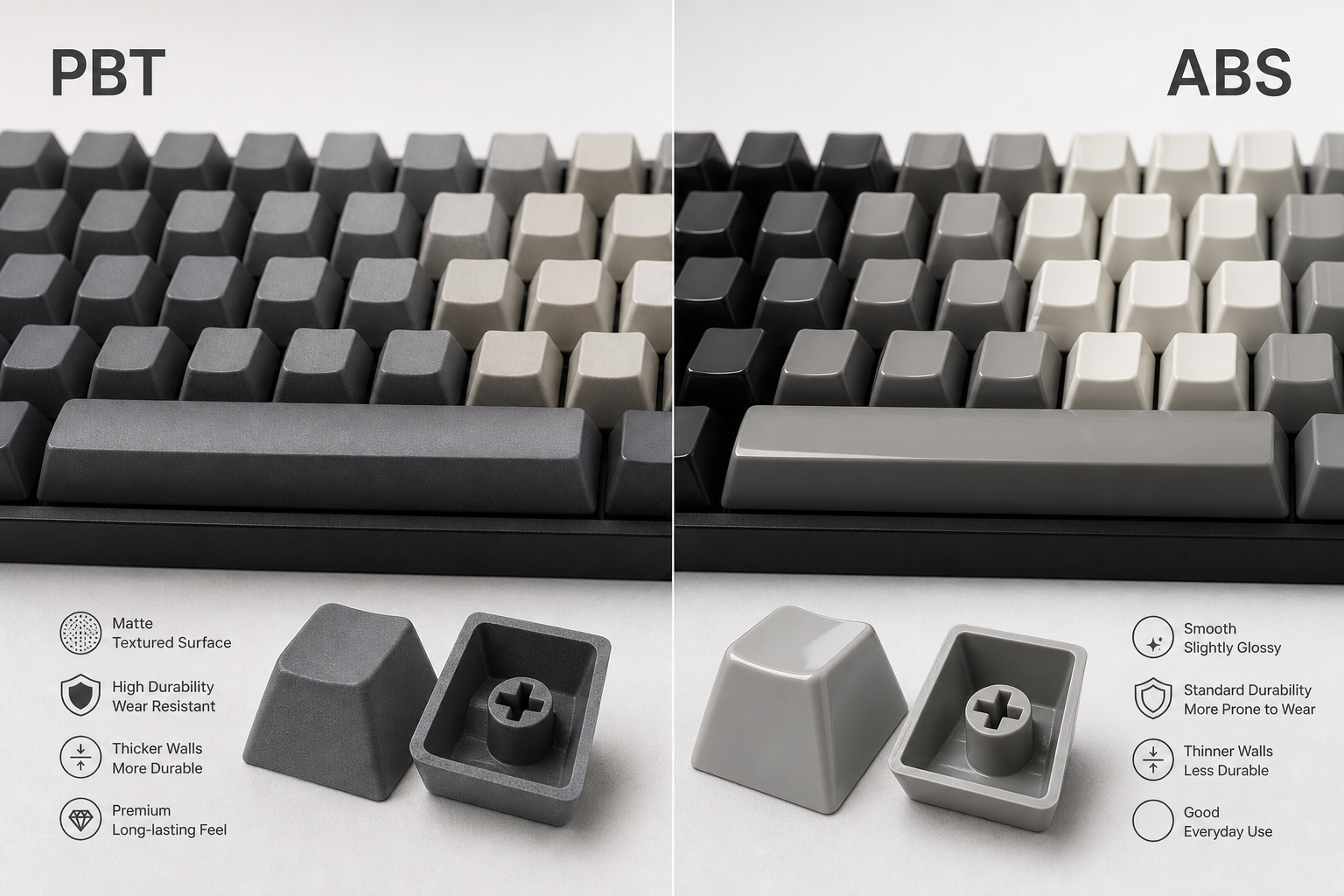
2. PBT vs ABS keycaps: material tradeoffs for B2B buyers
PBT and ABS are both common keycap plastics, but they behave differently in production and long-term use.
PBT keycaps
PBT is often selected for its matte texture, resistance to shine and durable feel. It is widely used for dye-sublimated keycaps and premium-feeling custom sets.
For B2B buyers, PBT is attractive when the product needs:
- A more durable surface feel
- Matte or textured finish
- Dye-sublimated legends
- Enthusiast or premium positioning
- Long-term visual stability under normal use
The tradeoff is manufacturing control. PBT generally requires more careful process management than ABS. Large keys such as spacebars may need closer QC because warping risk can be higher if material, cooling and mold conditions are not well controlled.
ABS keycaps
ABS is widely used because it is flexible in molding, color and shine-through applications. Many double-shot keycaps use ABS, especially where clear or translucent legend areas are required for RGB lighting.
ABS may be a good fit when the buyer needs:
- Shine-through legends
- Strong color flexibility
- Smooth surface feel
- Established double-shot options
- Cost-sensitive mass production
The tradeoff is surface aging. Lower-grade ABS keycaps may become shiny faster after heavy use. That does not mean ABS is always low quality; high-quality ABS double-shot keycaps can still be premium. The buyer should judge ABS by mold quality, wall thickness, legend process, color consistency and QC standard—not by material name alone.
3. Double-shot vs dye-sub: legend process matters
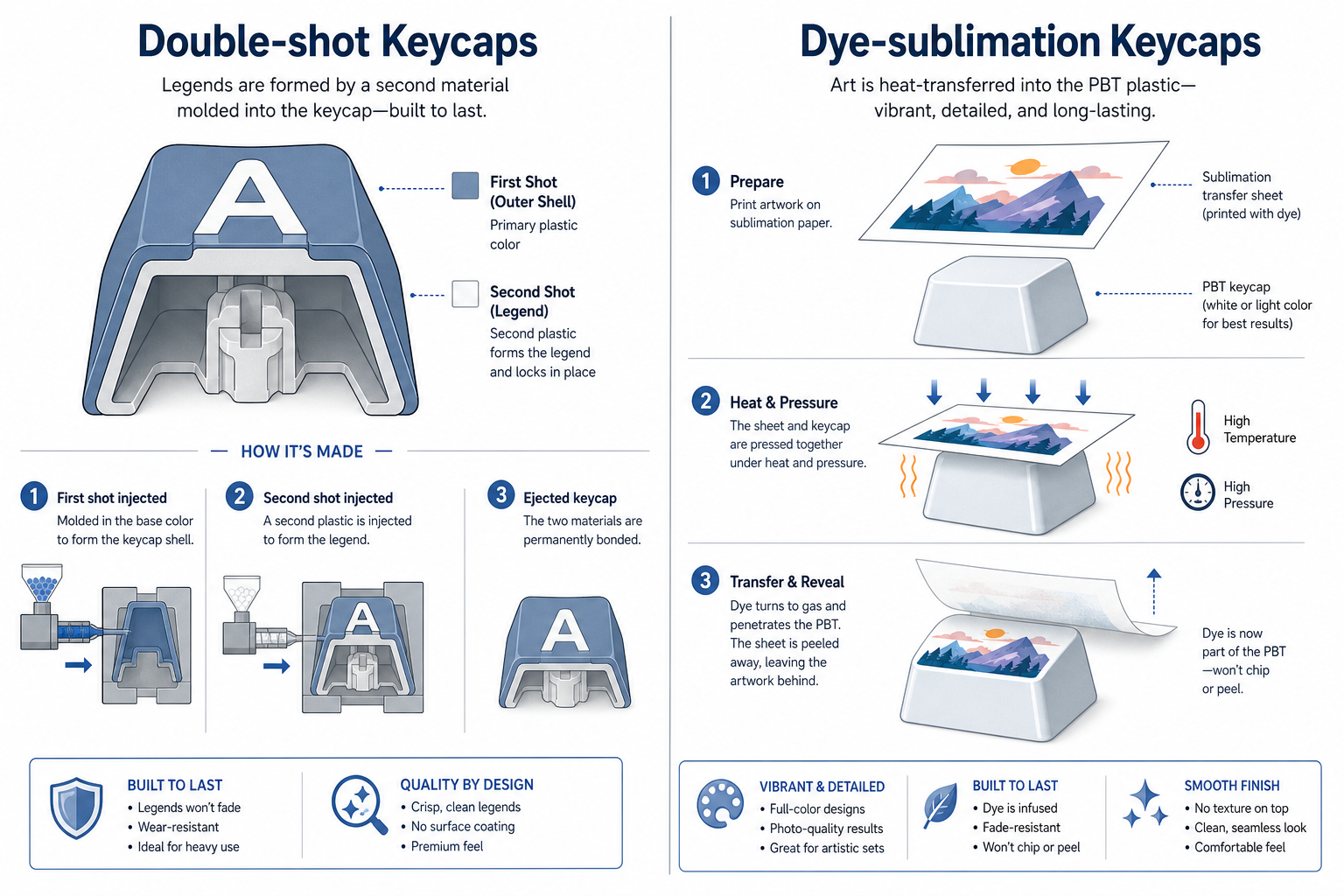
The legend process affects durability, design freedom, MOQ and tooling cost.
Dye-sublimation keycaps
Dye-sublimation uses heat to transfer dye into the surface of PBT keycaps. It is useful for themed designs, multilingual legends and small-to-mid batch customization.
Best use cases:
- Custom legends
- Regional layouts
- Themed keycap sets
- Lower MOQ projects
- Light-colored PBT keycaps with darker legends
Main limitation:
Dye-sub is not ideal when the buyer needs light legends on dark keycaps. It also does not create true shine-through legends. If RGB backlighting through the characters is required, double-shot or another compatible process is usually a better choice.
Double-shot keycaps
Double-shot keycaps are made by molding two plastic layers so the legend is physically part of the keycap structure. The legend does not simply sit on the surface.
Best use cases:
- Permanent legends
- High-use keyboard products
- Shine-through legends
- Dark keycaps with light legends
- Repeat SKUs with stable demand
Main limitation:
Double-shot usually requires more tooling planning. If every legend needs dedicated tooling, the upfront cost and MOQ pressure can increase. This is why double-shot makes more sense when the buyer expects repeat orders or a stable product line.
4. Keycap profiles: not just appearance
Keycap profile affects height, finger angle, typing feel, sound and compatibility. For B2B buyers, profile choice also affects market acceptance because customers may already expect a familiar typing feel.
Common options include:
| Profile | Type | Typical use |
|---|---|---|
| OEM | Sculpted, medium height | Common on mass-market mechanical keyboards |
| Cherry | Sculpted, lower than OEM | Popular for typing and enthusiast keyboards |
| XDA | Uniform, medium-low | Themed sets, clean visual style, flexible layouts |
| DSA | Uniform, low | Ortholinear, compact and custom layouts |
| SA | Tall, sculpted | Retro look, distinctive sound and enthusiast appeal |
For mainstream keyboard projects, OEM and Cherry are usually easier for customers to understand. For themed or enthusiast-focused sets, XDA, DSA or SA can create stronger visual differentiation, but the buyer should consider typing adaptation and market expectations.
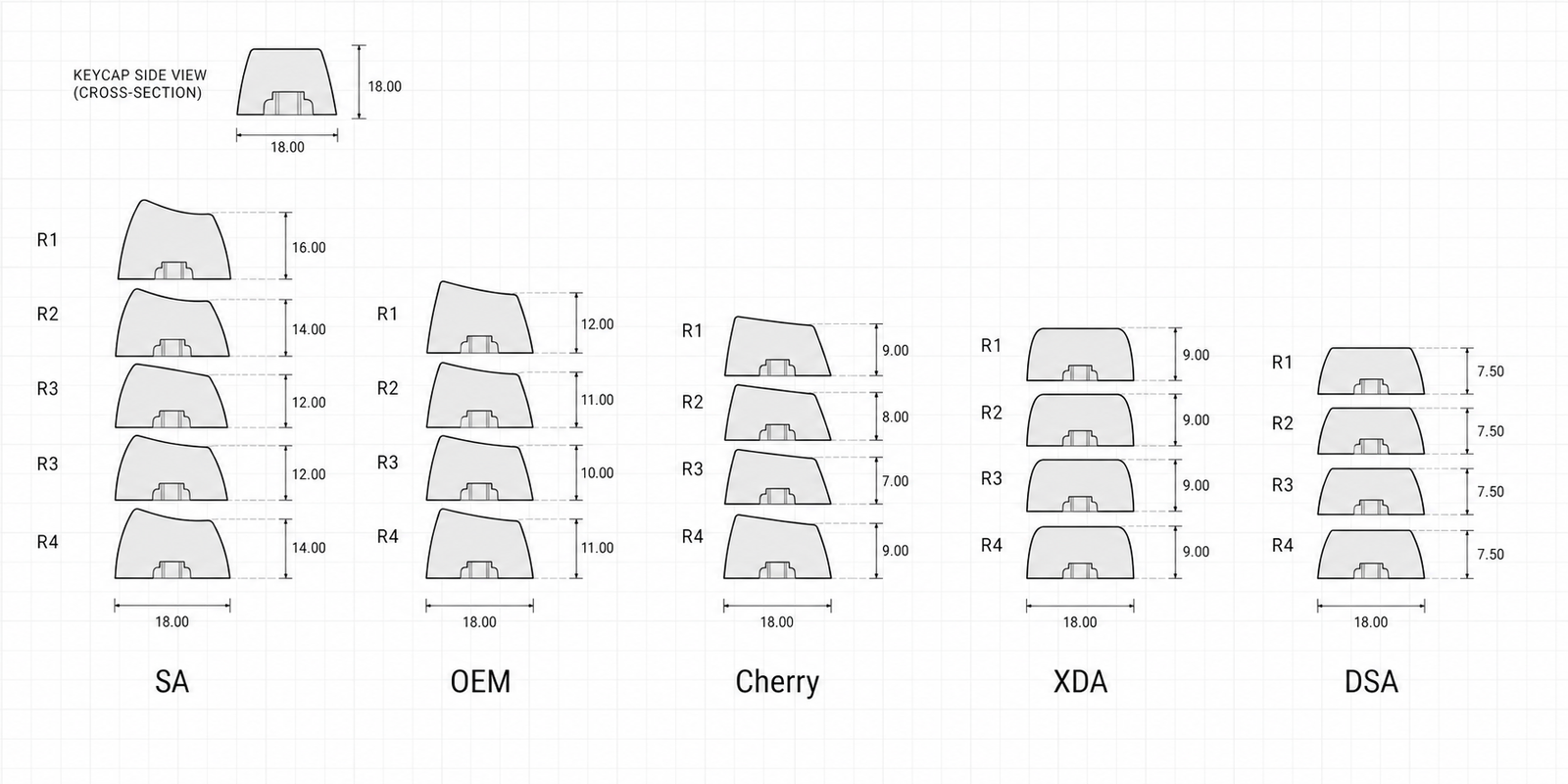
A profile decision should be confirmed early because it affects mold availability, layout coverage, packaging height and buyer expectations.
5. MOQ planning: what is realistic?
MOQ depends on the combination of material, legend process, mold availability, color requirement, packaging and QC expectations.
A lower MOQ is more realistic when the buyer uses:
- Existing molds
- Existing profile options
- Standard layouts
- Dye-sub on PBT
- Simple packaging
- Limited color complexity
MOQ becomes harder when the buyer needs:
- New profile tooling
- Double-shot legend molds
- Many language/layout variations
- Special colors requiring repeated matching
- Complex novelty keys
- Retail packaging with inserts, trays or sleeves
For small keyboard brands, the safest approach is often to start with an existing mold and a practical customization method, then move to deeper tooling after demand is proven.
6. What drives custom keycap cost?
Custom keycap cost is not only plastic cost. Buyers should separate one-time development costs from repeat production costs.
Main cost factors include:
- Material: PBT, ABS or other plastics
- Profile and mold availability
- Legend method: dye-sub, double-shot, UV print, laser or pad print
- Number of keys in the kit
- Layout support: ANSI, ISO, Mac, regional layouts, novelty keys
- Color matching requirements
- Wall thickness and quality standard
- Sample rounds
- Defect tolerance
- Packaging type
- Inspection and sorting labor
- Shipping volume and carton planning
A cheap quote may exclude important details such as extra keys, packaging, color matching, replacement rate or QC criteria. A better RFQ should force these items into the quotation from the beginning.
7. QC points buyers should confirm before production
Keycap quality issues are often small but visible. They can create customer complaints even when the keyboard itself works well.
Important QC checkpoints include:
- Stem fit and looseness
- Warping on long keys
- Legend alignment
- Color consistency across keys
- Surface texture consistency
- Burrs or injection marks
- Wall thickness
- Spacebar straightness
- Layout completeness
- Packaging protection
- Batch-to-batch consistency
For repeat B2B orders, the buyer should keep approved samples and compare later production batches against them.
8. Packaging and private label planning
Packaging should be decided before production, not after production is finished.
Common options include:
- Neutral tray or bag packaging
- Simple white box
- Private label sticker
- Printed retail box
- Plastic tray with sleeve
- Full retail packaging with barcode and inserts
For distributors, packaging affects shelf readiness and warehouse handling. For e-commerce brands, packaging affects customer perception and return risk. For OEM keyboard bundles, packaging must match the keyboard product plan.
If the keycaps are sold as a standalone retail product, packaging should protect the set and clearly show layout compatibility.
9. RFQ checklist for custom keycap buyers
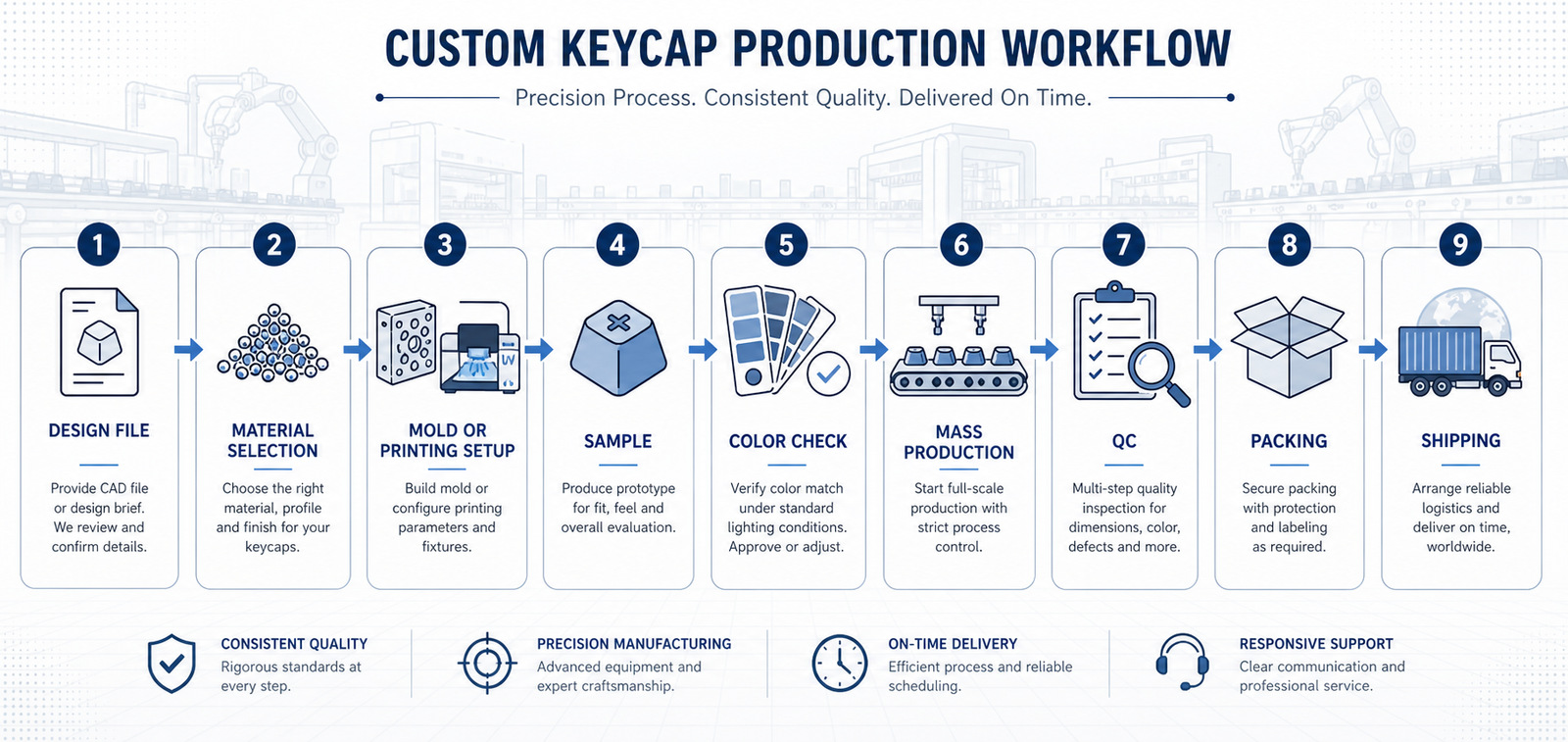
A clear RFQ helps the factory quote accurately and recommend the right production path.
Before asking for a price, prepare:
- Target quantity for first order
- Expected repeat order quantity
- Material preference: PBT or ABS
- Legend method: dye-sub, double-shot, laser, UV or undecided
- Profile: Cherry, OEM, XDA, DSA, SA or other
- Layout: ANSI, ISO, 60%, 65%, 75%, TKL, 96%, full-size, Mac or regional
- Total key count
- Color reference: Pantone, sample or product photo
- Artwork files for legends or novelty keys
- Packaging requirement
- Target market
- Required certifications or compliance needs, if any
- Shipment destination
- Timeline for sample and mass production
If the buyer is unsure, the RFQ should say “undecided” instead of guessing. A good manufacturer can then recommend a practical route based on MOQ, budget and use case.
10. Recommended production path by buyer type
Small keyboard brand testing demand
Start with PBT dye-sub or existing mold customization. Avoid heavy tooling unless there is a clear repeat-order plan.
Distributor building a private-label catalog
Use stable profiles, common layouts and packaging that supports wholesale handling. Prioritize consistency and repeat supply.
Gaming keyboard brand
Confirm shine-through needs early. If RGB legend visibility is important, double-shot or compatible shine-through processes should be considered.
Enthusiast-themed keycap project
Focus on artwork, profile, kitting and color matching. Dye-sub may be practical for flexible design, while double-shot may suit higher-volume premium SKUs.
OEM keyboard bundle
Match keycap material, profile and packaging to the keyboard’s price point. Do not overbuild the keycap if the keyboard itself is positioned as entry-level.
Final recommendation
A strong custom keycap project starts with the production route, not the artwork alone.
For most first-batch buyers, the practical path is:
- Confirm buyer type and target market
- Choose material based on feel, durability and lighting needs
- Choose legend process based on design, MOQ and repeat plan
- Confirm profile and layout
- Build a complete RFQ
- Approve samples before mass production
- Lock QC criteria and packaging before shipment
AllwinKey can help keyboard brands, distributors and OEM buyers compare PBT, ABS, dye-sub, double-shot, profile, MOQ and packaging options before committing to production.
FAQ Section
What is the best material for custom keycaps, PBT or ABS?
There is no single best material for every project. PBT is often preferred for matte texture, resistance to shine and dye-sublimation designs. ABS is often useful for flexible colors, shine-through legends and established double-shot production. The better choice depends on lighting needs, order quantity, profile, budget and target market.
Are double-shot keycaps better than dye-sub keycaps?
Double-shot keycaps are better when the buyer needs permanent legends, shine-through legends or a long-term repeat SKU. Dye-sub keycaps are often better for custom artwork, regional layouts, themed sets and lower MOQ PBT projects. The right process depends on design requirements and production volume.
What MOQ is realistic for custom keycaps?
MOQ depends on whether the buyer uses existing molds, standard profiles and simple packaging, or requires new tooling, double-shot legend molds, custom colors and complex retail packaging. Lower MOQ is usually more realistic with existing molds and dye-sub customization. New tooling and complex double-shot projects usually require stronger volume planning.
Which keycap profile should a keyboard brand choose?
OEM and Cherry profiles are usually safer for mainstream keyboard products because many users already understand the typing feel. XDA, DSA and SA can help themed or enthusiast products stand out, but buyers should consider customer expectations, layout compatibility and packaging height before choosing.
What information should be included in a custom keycap RFQ?
A useful RFQ should include target quantity, expected repeat order, material, legend method, profile, layout, total key count, color references, artwork files, packaging needs, destination market, shipment destination and timeline. If a buyer is unsure about a decision, it is better to state “undecided” so the factory can recommend a practical route.